Showing posts with label choice. Show all posts

Tuesday, December 1, 2015

Random thoughts on balancing choice and challenge

As is obvious from a few of my previous posts, I am a huge advocate of allowing children to make free reading choices:

Not only is this a proven strategy for improving reading ability, it also develops a positive association with reading, which is more likely to lead someone to identify as a reader than if it becomes a source of anxiety because adults decide that the books you like are not "the right ones."

These lines from Jacqueline Woodson's gorgeous memoir, the National Book Award winner Brown Girl Dreaming, poignantly speak to this:

"Every Monday, my mother takes us
to the library around the corner. We are allowed
to take out seven books each. On those days,
no one complains
that all I want are picture books.

Those days, no one tells me to read faster
to read harder books
to read like Dell.

No one is there to say, Not that book,
when I stop in front of the small paperback
with a brown boy on the cover.
Stevie."

Challenge is a great thing, but it's different when you choose a challenging book because it excites you. And of course "challenge" can mean many different things. We all pick up books for many reasons - relaxation, escape, nostalgia, to learn about a subject that excites us, to be able to talk with peers, to appreciate beautiful art, to laugh, to cry - and it's crucial that we let children explore all these types of reading.

Still, there are times when readers of all ages can get stuck in a rut - and there are ways to make stepping outside your usual comfort zone fun and engaging. Lately much of my kid and teen reading list has come from two sources:
I was thrilled to be given a spot in the Bill Morris Seminar, and my desire to participate is motivation enough for me to engage even with the titles I might not have picked up on my own, some of which are turning out to be new favorites!

The same goes for the book club, whose members include authors, school librarians and children's booksellers. Each month's host chooses the book we'll read, so I'm discovering new books there as well.

I have a few ways of offering kids choices and nudging them to challenge themselves with something different. One is the Battle of the Books, which our Middle School is trying for the first time this year in a competition against Overlake School in February. Students select most of the titles on the list, and must read at least 4 of the 12 to participate.

Book clubs, which I run during lunch and recess or breaks for grades 3 and up, also expose students to a variety of books and genres they might not otherwise try - but the fun of sharing with peers is encouragement enough.

If you're concerned about your child's limited reading choices, instead of saying "no" to the ones they're choosing, try to find fun ways to help them say "yes" to other books too:
  • play audiobooks in the car or at home
  • read together (you don't stop eating together when your child can feed herself, so don't stop reading aloud once they can read independently!)
  • spend more leisurely time browsing in a library or bookstore
  • join or start a parent-child book club
  • start reading some of these other books yourself and share your excitement in a dinner table conversation

Thursday, October 17, 2013

Neil Gaiman speaks his mind: Let children read the books they love

Arguably one of today's most popular and critically acclaimed authors, Neil Gaiman delivered a passionate defence this week of letting children read the books they enjoy. It's well worth your time to check out the full text of his speech, but in the meantime, here are some quotes that really spoke to me:


"The simplest way to make sure that we raise literate children is to teach them to read, and to show them that reading is a pleasurable activity. And that means, at its simplest, finding books that they enjoy, giving them access to those books, and letting them read them. 
I don't think there is such a thing as a bad book for children. Every now and again it becomes fashionable among some adults to point at a subset of children's books, a genre, perhaps, or an author, and to declare them bad books, books that children should be stopped from reading.
It's tosh. It's snobbery and it's foolishness. There are no bad authors for children, that children like and want to read and seek out, because every child is different. They can find the stories they need to, and they bring themselves to stories. A hackneyed, worn-out idea isn't hackneyed and worn out to them. This is the first time the child has encountered it. Do not discourage children from reading because you feel they are reading the wrong thing. Fiction you do not like is a route to other books you may prefer. And not everyone has the same taste as you."

~~~

Thinking back on your childhood, were there books you loved that grownups disapproved of? Or books you didn't like that grownups attempted to foist on you? I feel fortunate in that my parents paid little attention to what I read, but a great deal of attention to insuring that I had the opportunity to read widely, from weekly trips to the public library to heaps of books all over the house.

If anyone looks down on your kids' reading choices (or your own!), just tell them you've got Neil Gaiman on your side!

Thursday, September 5, 2013

Growing better readers

Welcome back to the new school year! It's so nice to see everyone back at school, refreshed and ready for another year of learning.

I was intrigued to learn recently that having parents who love to read not only sends the message that reading is a valuable activity, it also correlates with measurably better reading scores! You already know that reading with your child will help, but simply doing your own pleasure reading around your child will also have a positive impact.

According to a 2012 publication from the Organisation for Economic Co-operation and Development entitled Let's Read Them a Story! The Parent Factor in Education:

"In all countries and economies assessed, the children whose parents do not think reading is a waste of time or who spend more time reading at home for enjoyment have significantly higher scores in reading. ...in [some] countries, children whose parents spend time reading for enjoyment at home score more than 30 points – the equivalent of nearly a full school year – higher in reading than children whose parents do not."

The remarkable thing is that this difference persists within a single social class: "even when families of similar socio-economic backgrounds are considered, there is still a strong link between parents’ habits and attitudes towards reading and student reading performance. That means that the relationship is not dependent on the socio-economic background of the family."

Other findings, such as that "in all countries and economies surveyed, children whose parents consider reading a hobby, enjoy going to the library or bookstore, and spend time reading for enjoyment at home are more likely to enjoy reading themselves," were less surprising since children often enjoy the activities they're raised around, whether that means sports, board games, cooking, hiking or reading.
According to OECD, it doesn't matter what you read; it doesn't have to be long novels if that's not your thing (just like not all children enjoy fiction - many gravitate towards how-to books, joke books, comics or other choices). What matters is taking the time to read for pleasure, to go to bookstores and libraries, to talk about what you read, and to give your child the time and space to do the same.

Monday, April 22, 2013

Matt Haig's 30 Things to Tell a Book Snob

Not that any of you are book snobs, naturally! But unfortunately they are out there and this wonderful blog post sums up concisely and eloquently exactly how I feel, particularly this pithy sentence: "If books ever die, snobbery would be standing over the corpse."

Children are especially vulnerable to the judgments of book snobs, since their tastes are evolving, they do not critique books in the same way as adults, and they have not begun to read what they think they "should" as opposed to what they really wish to.

Thursday, December 1, 2011

What Makes a Book "Challenging Enough"?

This week I've been speaking with 7th and 8th graders about this year's Student Diversity Leadership Retreat which I am excited to be helping to plan and chaperone. This year's theme is media and becoming a more savvy, aware consumer of all forms of media. To spark the students' interest, I showed them a couple of television commercials and asked them to dissect the stereotypes they contained. I was impressed with their ability to look beyond the surface joke or message and recognize the common cultural assumptions or stereotypes that the ads were building on.

This got me thinking about a common request I have, which is to provide children with books that are "challenging enough." The question is, how do you define "challenging"? Just as you can relax on the sofa and mindlessly watch television, you can also take even the most vapid programming and analyze it in a complex way. Books are very similar!

Recently I had a wonderful conversation with a parent who said that her daughter didn't need to be challenged just by reading books with vocabulary levels at the upper limits of her comprehension because she recognized that challenge can come from complex ideas expressed in relatively simple language. This is especially true with realistic fiction, which usually portrays people speaking in naturalistic ways.

Three books I shared with students this week highlight this idea: Wild Wings by Gill Lewis, a chapter book I've been reading to 4th graders in connection with our information literacy exercises, and Traction Man Is Here! and Traction Man Meets Turbodog by Mini Grey, which are part of our kindergarten and 1st grade author unit on this very creative woman.

Wild Wings is not very difficult in terms of reading level, however it raises a number of challenging topics. There is a child in the book who is living in poverty. This is not stated outright, but is indicated through various contextual clues. In one scene she comes to school with no lunch, claiming she forgot it. In every 4th grade class we discussed this scenario: what appeared to be happening vs. the actual situation. Most students initially accepted at face value the idea that she forgot her lunch. However, every class had one child who suggested that this was her way of avoiding the embarrassment of admitting they didn't have enough food at home for her to bring any lunch. This insight led to some interesting conversations between the students about how people behave when they feel different, how peers can react in a kind and supportive way, and so on. This book, which might seem "easy" going just by reading level or vocabulary, is actually quite rich in meaning.

With the Mini Grey picture books, there were interesting contrasts in the developmental levels of most 1st graders as compared to most kindergartners. They are about a small boy engaging in imaginary play with his action figure. Many kindergartners initially interpreted the stories as being about a real, animated little person, rather than about a child playing the way they do with their own stuffed animals, dolls, action figures, etc., setting up scenarios using household objects and giving voice to an inanimate object. There is one scene in the second book in which Turbodog, an electronic toy, wakes up a sleeping cat. Traction Man comments, "Well, thanks for that, Turbodog." This simple statement is actually fairly complex, since the reader must understand that it was used sarcastically to actually mean the opposite. Both books contain many layers of meaning in pictures and text, as well as implied value statements about creativity and imagination - all conveyed through very little text, most of which is quite simple.

When you see your child reading an apparently too easy book, it can be a great opportunity to challenge him or her to think more deeply about the material! Wondering where to start with this discussion? Try this list of Universal Questions that work well for chapter books. With picture books, I also like to ask some of the following:

What kind of techniques or materials do you recognize in the art work? Why do you think the illustrator chose to use these materials?

Why do you think the illustrator drew [point to example] in this way? How else might he/she have drawn this? Why choose this part of a scene to illustrate, rather than something else? Do the pictures communicate the same meaning as the words? Or do they contradict each other? Why do you think that is?

Why do you think the words were printed on the page in this way? Would it have made a difference in how you feel about the book if the font were different?

Tuesday, August 23, 2011

Comfort books

The other day my soon-to-be-9th grader asked me what my "comfort book" was (hers is Roald Dahl's The Witches). I love this idea of a book that is reassuring and nurturing in its familiarity and association with carefree, happy times. Much like the power of comfort foods, comfort reads can soothe us in times of stress.

I often see students picking up books that are "too easy," but which are meaningful to them for this very reason. They line up to check out these beloved books and share with me how very special they are, perhaps through association with a fond relative or favorite teacher or because something about the plot or characters speaks deeply to them (even if they cannot articulate exactly how or why).

Sometimes this is concerning to parents - that a child is reading below his or her current level - but reading can be a powerful emotional experience, and nostalgic forays into favorite titles from earlier in life build a positive association with books and are nothing to fear.

So, what is my comfort book? No question, it is C.S. Lewis's The Lion, the Witch and the Wardrobe. The first time Lucy steps through the wardrobe into Narnia is seared into my brain as the single most magical moment in all of literature. Hmm, I might just have to pick it up again sometime very soon!

Tuesday, February 2, 2010

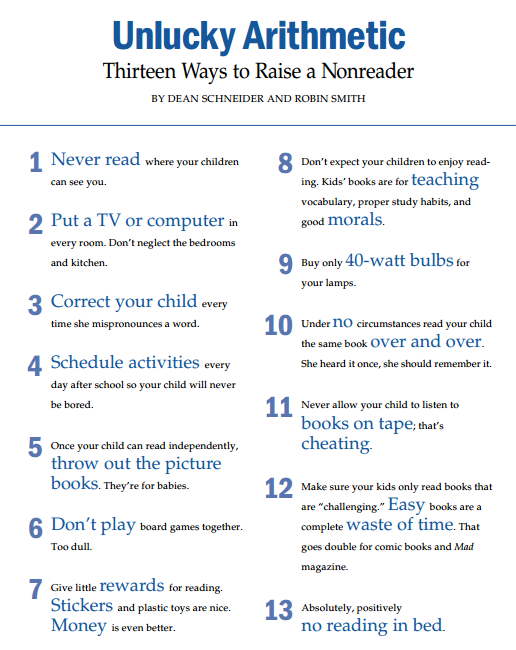
Thirteen Ways to Raise a Nonreader

Here for your enjoyment is Unlucky Arithmetic, a tongue-in-cheek guide from Horn Book magazine with a very serious point to make! If you want to make sure your child is a reader for life, check out this list - and then do the opposite!

Tuesday, October 27, 2009

The importance of independent reading choices

Many parents feel concern over the reading choices their children make. However, independent reading - reading purely for the joy of it - is a crucial part of a child's overall academic development. Intuitively, I believe we all know that children (and adults!) are more likely to find pleasure in reading if they are able to choose the books that speak to them. Fortunately, there is sound evidence showing that letting children read what they like is beneficial.

I highly encourage parents and children to keep reading logs. These can be in a notebook or online, using a site such as Goodreads or Library Thing, or even in a simple Excel spreadsheet. If you track your reading over time, you will likely notice it going in waves as your interests change. Perhaps you'll go through a phase of Civil War fiction followed by books that help you plan your next summer vacation followed by contemporary Irish fiction followed by spy thrillers.

Similarly your child may be in the midst of a reading phase you don't particularly like right now - but if you keep track, odds are it will soon be succeeded by another and then yet another... the main thing is to keep alive that passion and excitement about reading in whatever form it takes!The latest issue of Knowledge Quest, the journal of the American Association of School Librarians has an article called “Anything but Reading” by Stephen Krashen (professor emeritus from the University of Southern California in linguistics & education). He is a well-known advocate for children and reading. This article surveys 19 controlled academic studies of children and reading. The following quotes summarize it well:

“[The] studies show that those who read more read better. They also write better, spell better, have larger vocabularies and have better control of complex grammatical constructions.”

“The research literature also contains a number of case histories, cases in which self-selected voluntary reading resulting in unmistakable improvement in reading and other aspects of literacy. These studies are ‘scientific’ in that there was no other possible source of the improvement other than reading.”

“Even more convincing are experimental studies in which students who do self-selected reading for a given amount of time are compared to students who devote the same amount of time to ‘regular’ instruction. Self-selected reading has been a consistent winner in these studies…”

“In all studies time was set aside for self-selected reading, and readers were compared to similar students who did not have reading time included as part of their English program… [W]ithout exception, the readers did better than those in the comparison group.”

“[A]vailability of a school library is a very strong predictor of reading scores – nearly as strong as the effect of poverty…” [Laura’s note: the school library is a place where children have a source of books they can self-select from!]

“[T]he consistent winner in all the studies discussed here is self-selected reading. Nevertheless, self-selected reading is still a hard sell. People seem to be attracted to nearly every possible means of improving reading ability other than the most obvious…”

Of course, this is not to say that reading instruction is unnecessary – far from it! Rather, we must not underestimate the crucial importance of allowing children to self-select reading materials to supplement instructional time. Model a wide-ranging love for books and give time for reading prominence in your family's life and everything else will follow.