Showing posts with label reading. Show all posts

Tuesday, December 1, 2015

Random thoughts on balancing choice and challenge

As is obvious from a few of my previous posts, I am a huge advocate of allowing children to make free reading choices:

Not only is this a proven strategy for improving reading ability, it also develops a positive association with reading, which is more likely to lead someone to identify as a reader than if it becomes a source of anxiety because adults decide that the books you like are not "the right ones."

These lines from Jacqueline Woodson's gorgeous memoir, the National Book Award winner Brown Girl Dreaming, poignantly speak to this:

"Every Monday, my mother takes us
to the library around the corner. We are allowed
to take out seven books each. On those days,
no one complains
that all I want are picture books.

Those days, no one tells me to read faster
to read harder books
to read like Dell.

No one is there to say, Not that book,
when I stop in front of the small paperback
with a brown boy on the cover.
Stevie."

Challenge is a great thing, but it's different when you choose a challenging book because it excites you. And of course "challenge" can mean many different things. We all pick up books for many reasons - relaxation, escape, nostalgia, to learn about a subject that excites us, to be able to talk with peers, to appreciate beautiful art, to laugh, to cry - and it's crucial that we let children explore all these types of reading.

Still, there are times when readers of all ages can get stuck in a rut - and there are ways to make stepping outside your usual comfort zone fun and engaging. Lately much of my kid and teen reading list has come from two sources:
I was thrilled to be given a spot in the Bill Morris Seminar, and my desire to participate is motivation enough for me to engage even with the titles I might not have picked up on my own, some of which are turning out to be new favorites!

The same goes for the book club, whose members include authors, school librarians and children's booksellers. Each month's host chooses the book we'll read, so I'm discovering new books there as well.

I have a few ways of offering kids choices and nudging them to challenge themselves with something different. One is the Battle of the Books, which our Middle School is trying for the first time this year in a competition against Overlake School in February. Students select most of the titles on the list, and must read at least 4 of the 12 to participate.

Book clubs, which I run during lunch and recess or breaks for grades 3 and up, also expose students to a variety of books and genres they might not otherwise try - but the fun of sharing with peers is encouragement enough.

If you're concerned about your child's limited reading choices, instead of saying "no" to the ones they're choosing, try to find fun ways to help them say "yes" to other books too:
  • play audiobooks in the car or at home
  • read together (you don't stop eating together when your child can feed herself, so don't stop reading aloud once they can read independently!)
  • spend more leisurely time browsing in a library or bookstore
  • join or start a parent-child book club
  • start reading some of these other books yourself and share your excitement in a dinner table conversation

Tuesday, March 31, 2015

Reading and empathy: seeing the world from another's shoes

"Empathy" is a popular buzzword of late. Articles explaining how reading fiction develops empathy pop up regularly in the news. That said, other voices remind us that empathy is not a magic cure-all:

"Empathy is biased; we are more prone
to feel empathy for attractive people
and for those who look like us or share
our ethnic or national background."

All of which is complex and intriguing, especially when you encounter a book that has huge kid appeal and exemplifies the sort of empathy that helps us connect across differences as Steven Arntson's The Wrap-Up List does.

My new article, "Growing Empathic Readers," appears in the spring issue of The Medium, pp. 22-23. In it, I describe a conversation with Steven in which he describes, among other things, how he successfully bridges gaps and how he's challenged students to question their own beliefs. His insights offer something for all of us to ponder!

Thursday, October 17, 2013

Neil Gaiman speaks his mind: Let children read the books they love

Arguably one of today's most popular and critically acclaimed authors, Neil Gaiman delivered a passionate defence this week of letting children read the books they enjoy. It's well worth your time to check out the full text of his speech, but in the meantime, here are some quotes that really spoke to me:


"The simplest way to make sure that we raise literate children is to teach them to read, and to show them that reading is a pleasurable activity. And that means, at its simplest, finding books that they enjoy, giving them access to those books, and letting them read them. 
I don't think there is such a thing as a bad book for children. Every now and again it becomes fashionable among some adults to point at a subset of children's books, a genre, perhaps, or an author, and to declare them bad books, books that children should be stopped from reading.
It's tosh. It's snobbery and it's foolishness. There are no bad authors for children, that children like and want to read and seek out, because every child is different. They can find the stories they need to, and they bring themselves to stories. A hackneyed, worn-out idea isn't hackneyed and worn out to them. This is the first time the child has encountered it. Do not discourage children from reading because you feel they are reading the wrong thing. Fiction you do not like is a route to other books you may prefer. And not everyone has the same taste as you."

~~~

Thinking back on your childhood, were there books you loved that grownups disapproved of? Or books you didn't like that grownups attempted to foist on you? I feel fortunate in that my parents paid little attention to what I read, but a great deal of attention to insuring that I had the opportunity to read widely, from weekly trips to the public library to heaps of books all over the house.

If anyone looks down on your kids' reading choices (or your own!), just tell them you've got Neil Gaiman on your side!

Thursday, September 5, 2013

Growing better readers

Welcome back to the new school year! It's so nice to see everyone back at school, refreshed and ready for another year of learning.

I was intrigued to learn recently that having parents who love to read not only sends the message that reading is a valuable activity, it also correlates with measurably better reading scores! You already know that reading with your child will help, but simply doing your own pleasure reading around your child will also have a positive impact.

According to a 2012 publication from the Organisation for Economic Co-operation and Development entitled Let's Read Them a Story! The Parent Factor in Education:

"In all countries and economies assessed, the children whose parents do not think reading is a waste of time or who spend more time reading at home for enjoyment have significantly higher scores in reading. ...in [some] countries, children whose parents spend time reading for enjoyment at home score more than 30 points – the equivalent of nearly a full school year – higher in reading than children whose parents do not."

The remarkable thing is that this difference persists within a single social class: "even when families of similar socio-economic backgrounds are considered, there is still a strong link between parents’ habits and attitudes towards reading and student reading performance. That means that the relationship is not dependent on the socio-economic background of the family."

Other findings, such as that "in all countries and economies surveyed, children whose parents consider reading a hobby, enjoy going to the library or bookstore, and spend time reading for enjoyment at home are more likely to enjoy reading themselves," were less surprising since children often enjoy the activities they're raised around, whether that means sports, board games, cooking, hiking or reading.
According to OECD, it doesn't matter what you read; it doesn't have to be long novels if that's not your thing (just like not all children enjoy fiction - many gravitate towards how-to books, joke books, comics or other choices). What matters is taking the time to read for pleasure, to go to bookstores and libraries, to talk about what you read, and to give your child the time and space to do the same.

Monday, April 22, 2013

Matt Haig's 30 Things to Tell a Book Snob

Not that any of you are book snobs, naturally! But unfortunately they are out there and this wonderful blog post sums up concisely and eloquently exactly how I feel, particularly this pithy sentence: "If books ever die, snobbery would be standing over the corpse."

Children are especially vulnerable to the judgments of book snobs, since their tastes are evolving, they do not critique books in the same way as adults, and they have not begun to read what they think they "should" as opposed to what they really wish to.

Monday, March 11, 2013

The benefits of reading fiction

A University of Buffalo study found that when reading fiction, you actually benefit in several ways, partly by improving in the area of "social thinking" (understanding what the world is like for others) and partly by reaping the benefits that come from social belonging. Many of us have had the experience of feeling as if characters in a book were so real they were people we actually know. Now there is a study that confirms this actually happens and that we are changed by these fictional social encounters.

Commenting on this study, Professor Keith Oatley remarks, "If I read fiction, this kind of social thinking is what I get better at. If I read genetics or astronomy, I get more expert at genetics or astronomy. In fiction, also, we are able to understand characters' actions from their interior point of view, by entering into their situations and minds, rather than the more exterior view of them that we usually have. And it turns out that psychologically there is a big difference between these two points of view. We usually take the exterior view of others, but that's too limited. It is the first empirical finding, so far as I know, to show a clear psychological effect of reading fiction. It's a result that shows that reading fiction improves understanding of others, and this has a very basic importance in society, not just in the general way making the world a better place by improving interpersonal understanding, but in specific areas such as politics, business, and education."

Monday, October 22, 2012

Your reading brain

A recent NPR article, A Lively Mind: Your Brain On Jane Austen, described a researcher who put subjects into an fMRI machine and had them either dip into Jane Austen novels in a casual, browsing way, or else read them carefully and closely, as they would for an academic class. She wondered which parts of the brain would be activated when the way they read changed. The results were surprising! "Phillips found that close reading activated unexpected areas: parts of the brain that are involved in movement and touch. It was as though readers were physically placing themselves within the story as they analyzed it."

Check out this Stanford University article for a more in-depth discussion of this unique and fascinating study! Curious to learn more about how the brain responds to reading? Proust and the Squid is a wonderfully accessible and entertaining book that I can highly recommend!

Wednesday, May 2, 2012

"Do you have any good books in here?"

That's the question a student asked me the other day! It was an interesting question to contemplate because, really, what makes a book "good"? We have beloved childhood books we long to share with our kids, ones we remember fondly, one we believe are so good that they really must read them.

But sometimes those childhood, teen or early adult favorites don't hold up well so well when we re-read them later on, as Nadia Chaudhury's What Books Make You Cringe to Remember? so entertainingly shows. Celebrated author Neil Gaiman also describes the conundrum of Enid Blyton, one of the most widely read children's authors in the English language, who enlivened his boyhood but whom he finds unreadable years later.
Even when we're not looking back nostalgically through the mists of time, one person's favorite book is frequently someone else's stodgy bore. Every year, our kindergarten through 3rd grade students participate in a state-wide children's choice picture book award, and the process of selecting and voting for a favorite brings home to them quite vividly how different individual tastes can be, how "good book" isn't an easy concept to pin down.

As an adult in a position of authority, I am acutely aware that if I label a particular book as "good" or say, "You'll love this!" it might make a student uncomfortable if they don't care for it. So how did I answer this question? I said we had a lot of books that many people enjoyed, but that everyone had a different idea of which ones were "good." Then I asked him to describe what he liked and did my best to match him with something he'd enjoy - whether I really liked that book or not.

Monday, March 26, 2012

What are all those books doing to your brain?!

Ever since I found Maryanne Wolf's highly engaging Proust and the Squid: The Story and Science of the Reading Brain, I have been intrigued by the startling complexity of this seemingly simple task we engage in hundreds of times per day mostly without even being aware of it, from reading menus to traffic signs to text messages.

A recent New York Times article,
Your Brain on Fiction, describes recently discovered neurological effects of reading. For example, "Dr. Oatley and Dr. Mar, in collaboration with several other scientists, reported in two studies, published in 2006 and 2009, that individuals who frequently read fiction seem to be better able to understand other people, empathize with them and see the world from their perspective. This relationship persisted even after the researchers accounted for the possibility that more empathetic individuals might prefer reading novels. A 2010 study by Dr. Mar found a similar result in preschool-age children: the more stories they had read to them, the keener their theory of mind..."

Theory of mind refers to the "capacity of the brain to construct a map of other people’s intentions," and is crucial to being able to empathize and engage in healthy social interactions. The article points out this connection between fiction and important real world skills:
"Fiction, Dr. Oatley notes, 'is a particularly useful simulation because negotiating the social world effectively is extremely tricky, requiring us to weigh up myriad interacting instances of cause and effect. Just as computer simulations can help us get to grips with complex problems such as flying a plane or forecasting the weather, so novels, stories and dramas can help us understand the complexities of social life.'"

Apart from the sheer pleasure of it, I can't think of a better reason to make time in your life for curling up with a great novel!

Thursday, December 1, 2011

What Makes a Book "Challenging Enough"?

This week I've been speaking with 7th and 8th graders about this year's Student Diversity Leadership Retreat which I am excited to be helping to plan and chaperone. This year's theme is media and becoming a more savvy, aware consumer of all forms of media. To spark the students' interest, I showed them a couple of television commercials and asked them to dissect the stereotypes they contained. I was impressed with their ability to look beyond the surface joke or message and recognize the common cultural assumptions or stereotypes that the ads were building on.

This got me thinking about a common request I have, which is to provide children with books that are "challenging enough." The question is, how do you define "challenging"? Just as you can relax on the sofa and mindlessly watch television, you can also take even the most vapid programming and analyze it in a complex way. Books are very similar!

Recently I had a wonderful conversation with a parent who said that her daughter didn't need to be challenged just by reading books with vocabulary levels at the upper limits of her comprehension because she recognized that challenge can come from complex ideas expressed in relatively simple language. This is especially true with realistic fiction, which usually portrays people speaking in naturalistic ways.

Three books I shared with students this week highlight this idea: Wild Wings by Gill Lewis, a chapter book I've been reading to 4th graders in connection with our information literacy exercises, and Traction Man Is Here! and Traction Man Meets Turbodog by Mini Grey, which are part of our kindergarten and 1st grade author unit on this very creative woman.

Wild Wings is not very difficult in terms of reading level, however it raises a number of challenging topics. There is a child in the book who is living in poverty. This is not stated outright, but is indicated through various contextual clues. In one scene she comes to school with no lunch, claiming she forgot it. In every 4th grade class we discussed this scenario: what appeared to be happening vs. the actual situation. Most students initially accepted at face value the idea that she forgot her lunch. However, every class had one child who suggested that this was her way of avoiding the embarrassment of admitting they didn't have enough food at home for her to bring any lunch. This insight led to some interesting conversations between the students about how people behave when they feel different, how peers can react in a kind and supportive way, and so on. This book, which might seem "easy" going just by reading level or vocabulary, is actually quite rich in meaning.

With the Mini Grey picture books, there were interesting contrasts in the developmental levels of most 1st graders as compared to most kindergartners. They are about a small boy engaging in imaginary play with his action figure. Many kindergartners initially interpreted the stories as being about a real, animated little person, rather than about a child playing the way they do with their own stuffed animals, dolls, action figures, etc., setting up scenarios using household objects and giving voice to an inanimate object. There is one scene in the second book in which Turbodog, an electronic toy, wakes up a sleeping cat. Traction Man comments, "Well, thanks for that, Turbodog." This simple statement is actually fairly complex, since the reader must understand that it was used sarcastically to actually mean the opposite. Both books contain many layers of meaning in pictures and text, as well as implied value statements about creativity and imagination - all conveyed through very little text, most of which is quite simple.

When you see your child reading an apparently too easy book, it can be a great opportunity to challenge him or her to think more deeply about the material! Wondering where to start with this discussion? Try this list of Universal Questions that work well for chapter books. With picture books, I also like to ask some of the following:

What kind of techniques or materials do you recognize in the art work? Why do you think the illustrator chose to use these materials?

Why do you think the illustrator drew [point to example] in this way? How else might he/she have drawn this? Why choose this part of a scene to illustrate, rather than something else? Do the pictures communicate the same meaning as the words? Or do they contradict each other? Why do you think that is?

Why do you think the words were printed on the page in this way? Would it have made a difference in how you feel about the book if the font were different?

Tuesday, September 20, 2011

Create a Culture of Reading at Home

This week I'd like to share my guest post on the Mothering magazine blog entitled Create a Culture of Reading at Home. It addresses some of the questions I have been most frequently asked over the years and I hope you will find it interesting and helpful!

Tuesday, August 23, 2011

Comfort books

The other day my soon-to-be-9th grader asked me what my "comfort book" was (hers is Roald Dahl's The Witches). I love this idea of a book that is reassuring and nurturing in its familiarity and association with carefree, happy times. Much like the power of comfort foods, comfort reads can soothe us in times of stress.

I often see students picking up books that are "too easy," but which are meaningful to them for this very reason. They line up to check out these beloved books and share with me how very special they are, perhaps through association with a fond relative or favorite teacher or because something about the plot or characters speaks deeply to them (even if they cannot articulate exactly how or why).

Sometimes this is concerning to parents - that a child is reading below his or her current level - but reading can be a powerful emotional experience, and nostalgic forays into favorite titles from earlier in life build a positive association with books and are nothing to fear.

So, what is my comfort book? No question, it is C.S. Lewis's The Lion, the Witch and the Wardrobe. The first time Lucy steps through the wardrobe into Narnia is seared into my brain as the single most magical moment in all of literature. Hmm, I might just have to pick it up again sometime very soon!

Thursday, August 4, 2011

Characters coming to life

One of the most entertaining sessions I attended at the American Library Association conference in New Orleans was one in which several authors who won a Newbery with their first published novel talked about how it changed their lives.

Jennifer Holm, one of the panelists, worked in television broadcasting before eventually turning to writing full-time. She shared a sweet anecdote about a little boy who desperately loved her book Our Only May Amelia. Set in Washington state in the late 1800s, this story of a spirited Finnish American girl in a pioneer family was inspired by the diaries of Holm's great aunt, Alice Amelia, and set in Naselle, Washington, where some of her family remain to this day.

One day, Holm received a phone call from her grandparents, who reported that a little boy from Seattle had shown up asking to meet May Amelia! It was his spring break, and he had persuaded his family to drive him to Naselle, where he asked around about "where May Amelia lives" until he was finally directed to the Holm family farm.

Holm's grandparents took the little boy on a tractor tour of their farm and showed him Alice Amelia's diaries, and gently informed him that May Amelia was a fictional character. This story moved me deeply and was a reminder of how, when young people read, they are often consumed by stories in ways that are difficult to recapture as an adult.

Right now I'm in the middle of listening to a charming audiobook, The Wilder Life: My Adventures in the Lost World of Little House on the Prarie by Wendy McClure. The author recounts her wholehearted childhood belief in a parallel universe in which Laura Ingalls Wilder not only lived on, but could possibly come visit her for a tour of 1970s America! Similarly, The Magician's Book by Laura Miller is an absorbing tour through the author's childhood devotion to the Narnia series.

Sometimes parents worry when young people become consumed by a particular book or series, however, if you think back to your own childhood reading - or read books such as these about childhood reading obsessions - it can be reassuring to remember that this is not only normal and common, but something you may longingly wish to experience later in life!

Tuesday, February 2, 2010

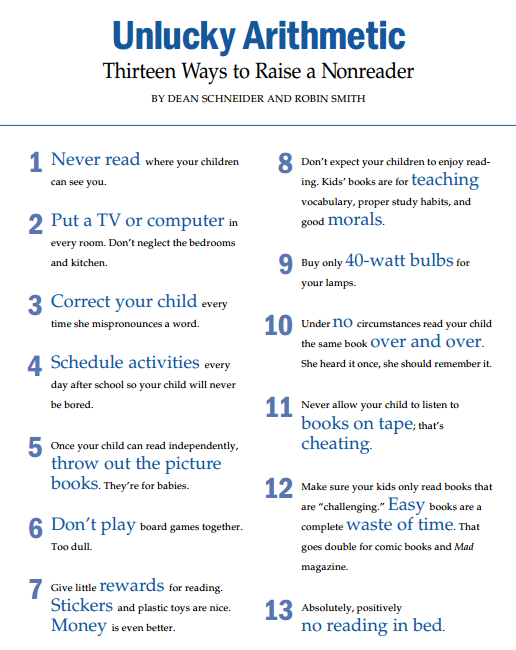
Thirteen Ways to Raise a Nonreader

Here for your enjoyment is Unlucky Arithmetic, a tongue-in-cheek guide from Horn Book magazine with a very serious point to make! If you want to make sure your child is a reader for life, check out this list - and then do the opposite!

Tuesday, October 27, 2009

The importance of independent reading choices

Many parents feel concern over the reading choices their children make. However, independent reading - reading purely for the joy of it - is a crucial part of a child's overall academic development. Intuitively, I believe we all know that children (and adults!) are more likely to find pleasure in reading if they are able to choose the books that speak to them. Fortunately, there is sound evidence showing that letting children read what they like is beneficial.

I highly encourage parents and children to keep reading logs. These can be in a notebook or online, using a site such as Goodreads or Library Thing, or even in a simple Excel spreadsheet. If you track your reading over time, you will likely notice it going in waves as your interests change. Perhaps you'll go through a phase of Civil War fiction followed by books that help you plan your next summer vacation followed by contemporary Irish fiction followed by spy thrillers.

Similarly your child may be in the midst of a reading phase you don't particularly like right now - but if you keep track, odds are it will soon be succeeded by another and then yet another... the main thing is to keep alive that passion and excitement about reading in whatever form it takes!The latest issue of Knowledge Quest, the journal of the American Association of School Librarians has an article called “Anything but Reading” by Stephen Krashen (professor emeritus from the University of Southern California in linguistics & education). He is a well-known advocate for children and reading. This article surveys 19 controlled academic studies of children and reading. The following quotes summarize it well:

“[The] studies show that those who read more read better. They also write better, spell better, have larger vocabularies and have better control of complex grammatical constructions.”

“The research literature also contains a number of case histories, cases in which self-selected voluntary reading resulting in unmistakable improvement in reading and other aspects of literacy. These studies are ‘scientific’ in that there was no other possible source of the improvement other than reading.”

“Even more convincing are experimental studies in which students who do self-selected reading for a given amount of time are compared to students who devote the same amount of time to ‘regular’ instruction. Self-selected reading has been a consistent winner in these studies…”

“In all studies time was set aside for self-selected reading, and readers were compared to similar students who did not have reading time included as part of their English program… [W]ithout exception, the readers did better than those in the comparison group.”

“[A]vailability of a school library is a very strong predictor of reading scores – nearly as strong as the effect of poverty…” [Laura’s note: the school library is a place where children have a source of books they can self-select from!]

“[T]he consistent winner in all the studies discussed here is self-selected reading. Nevertheless, self-selected reading is still a hard sell. People seem to be attracted to nearly every possible means of improving reading ability other than the most obvious…”

Of course, this is not to say that reading instruction is unnecessary – far from it! Rather, we must not underestimate the crucial importance of allowing children to self-select reading materials to supplement instructional time. Model a wide-ranging love for books and give time for reading prominence in your family's life and everything else will follow.

Thursday, May 7, 2009

Let books show you the way

People have long made pilgrimages to the locations of beloved books. Most recently Forks has been inundated with tourists from around the world eager to walk the same streets as the characters from the Twilight series!

If you are a lover of classic British children's fiction one of the most delightful books you can read is Joan Bodger's How the Heather Looks: A Joyous Journey to the British Sources of Children's Books. In the 1950s, Bodger traveled with her husband and two children, Ian and Lucy, around the British Isles. They visited the sites of many of their favorite books from Winnie-the-Pooh to The Wind in the Willows. They walked the same paths as Beatrix Potter and searched for signs of King Arthur and Robin Hood.

How the Heather Looks makes for inspirational armchair travel! If you want to try something similar closer to home, check out the Hannah West mystery series by Linda Johns. Perfect for mid-to-upper elementary and middle school, these are set in various Seattle neighborhoods (start with Hannah West in the Belltown Towers).

Tuesday, April 21, 2009

Proust and the Squid

Now there's a title you won't easily forget! Maryanne Wolf, a professor of child development and author of Proust and the Squid: The Story and Science of the Reading Brain, has pulled together material from a huge range of disciplines into one highly readable volume. I cannot recommend this book highly enough!

Proust and the Squid has something to offer everyone, whether you are a parent, an educator or just someone who is interested in language, history or the science of how the brain works. As Wolf points out, reading is not a natural or innate human activity; it is a relatively recent invention and not something that all human cultures have engaged in. Even among literate societies there is a tremendous range of approaches to writing, resulting in equally diverse challenges for the human brain. Different parts of the brain will be used when reading a highly regular phonetic language (such as Spanish or German) as opposed to a logographic language (e.g. Chinese) or a language that uses a mixture of logographic and phonetic writing systems (e.g. Japanese).

When you consider the many functions the brain must perform at incredible speeds to read even a simple line of text it is no wonder that children sometimes run into obstacles. Thanks to modern neuroscience we have a better understanding than ever of what form these obstacles take. The many reading challenges loosely grouped together under the heading "dyslexia" can actually be manifestations of very different problems, some of which are noticeable at very early ages while others may not become apparent until age 9 or 10.

Even if no one in your family has a reading disorder, Proust and the Squid will give you new respect for the amazing things that happen inside your child's head every time he or she picks up a book.

Tuesday, February 3, 2009

What happens in the brain when you read?

Scientists are starting to unravel this mystery! Listen and learn more: Reading Creates 'Simulations' in Minds.